Disquiet Junto School bus Friday pm


Disquiet Junto Project 0064: Composing from Memory

This week’s project's theme is composing from memory. It is recommended that you read through all the steps in the project before proceeding to attempt to execute it.

These are the steps:

Step 1: Find a place, preferably outdoors, where you can sit for five to fifteen minutes without being disturbed. This place should have a fair amount of inherent noise to it, and that noise should be variable, not static — i.e., not the long held drone of an overwhelmingly loud HVAC system, but the bustle of a street corner, or of a playground, or, if weather or other circumstances keep you indoors, perhaps of a busy cafe.

Step 2: Bring with you a portable recording device as well as something on which you can quietly take a small number of written (or typed) notes. You may wish to do a test recording to be certain that your note-taking isn't part of the audio recording.

Step 3: Settle into the space and get a sense of its sounds. Listening closely.

Step 4: Make a field recording of one full minute, or a little longer, of continuous sound in this place. While recording the sound, use time codes to make note of any memorable sonic instances.

Step 5: Trim the field recording to exactly 60 seconds.

Step 6: Without listening back to the field recording, compose and record a 60-second piece intended to complement it. Refer back to your time-code notes to align composed instances with those real-world instances that you recall having distinguished your field recording. You can use whatever instrumentation you like, but it is recommended that you use no more than one or two instruments. You should not employ any field recordings in your composed piece.

Step 7: When your composed piece is completed, layer the two tracks together into one new 60-second work. They should be played back at equal volume, more or less. You can adjust a little to achieve the impression of balance between the field recording and the composed work. The only editing you can do is to fade in and out, if that is so desired.

Deadline: Monday, March 25, 2013, at 11:59pm wherever you are.

Length: Your finished work should be 60 seconds long.

Information: Please when posting your track on SoundCloud, include a description of your process in planning, composing, and recording it. This description is an essential element of the communicative process inherent in the Disquiet Junto.

Title/Tag: When adding your track to the Disquiet Junto group on Soundcloud.com, please include the term “disquiet0064-halflive” in the title of your track, and as a tag for your track.

Download: Consider setting your track in a manner that allows for attributed, commerce-free remixing (i.e., a Creative Commons license permitting non-commercial sharing with attribution).

Linking: When posting the track, be sure to include this information:

More on this 64th Disquiet Junto project at:


More details on the Disquiet Junto at:


- end -


Soon after reading the Junto email I concluded that recording the school bus stopping outside my house on Friday afternoon would be a good field recording, for convenience as well as interesting material for my Rode NT4 stereo microphone.

Bass guitar was also settled on for convenience, as I've more experience on that instrument and I could use a light semi-acoustic model to spare my aching back.

After hitting record when the bus entered my street, I scribbled a few notes while watching the time on my Zoom H4. I can hear my eldest comment on seeing me but he decided not to try and get my attention. The 60-seconds ran out just before my daughter walked up to the microphone and asked what I was doing.

At first I wasn't sure what key to use, the bus sorta sounded like a D or maybe I just associate that low pitch with D. Anyway, I thought I'd pick something that wasn't D in case it clashed, remembering this riff using a C 7th (I think).

The idea was to progressively pick up the pace as the bus stops and the kids excitedly enter the scene, then I thought I'd ramp it up a bit more with the slapping while the bus roars away.

Disquiet Junto: Greg or Ian at the Park


Disquiet Junto Project 0063: Gregorian-orian-ian

This week’s project involves the role of architectural spaces in the composition of music. It is a shared-sample project that takes a piece of Gregorian chant as its source material.

These are the steps:

Step 1: Download this OGG audio file that contains a recording of monks singing Gregorian chant at the Abbey of Sant’Antimo in Italy:


Step 2: Play back that recording loudly in a highly reverberant space and record it. Your best bet may be a bathroom.

Step 3: Create a new piece of music using the recording you just made as your primary source material. You cannot add any new source material. You can manipulate the audio recording as you please, but restrict yourself to effects that simulate echo, such as delay, reverb, and looping. You may also use the original OGG file, but only in addition to your own recording of it being played back in the reverberant space.

Background: For additional thinking on the role that architecture has played in the evolution of music, this 2010 talk by David Byrne is recommended:


Deadline: Monday, March 18, 2013, at 11:59pm wherever you are.

Length: Your finished work should be between 1 and 4 minutes in length.

Information: Please when posting your track on SoundCloud, include a description of your process in planning, composing, and recording it. This description is an essential element of the communicative process inherent in the Disquiet Junto.

Title/Tag: When adding your track to the Disquiet Junto group on Soundcloud.com, please include the term “disquiet0063-gregorianorianian” in the title of your track, and as a tag for your track.

Download: Consider setting your track in a manner that allows for attributed, commerce-free remixing (i.e., a Creative Commons license permitting non-commercial sharing with attribution).

Linking: When posting the track, be sure to include this information:

More on this 63th Disquiet Junto project at:


More details on the Disquiet Junto at:


The source of this piece is a recording of monks singing Gregorian chant at the Abbey of Sant’Antimo in Italy:


- end -


On Friday afternoon I considered cranking the monks and recording them reverberating in my bathroom but I didn't get to it before my kids returned from school.

So I thought the drains at the park might be interesting, putting my 3V sound system at one end of the storm water drain and my Rode NT4 stereo mic at the other.

The noise from the nearby rice processing facility added a nice low rumble and there were some birds chirping too, a bit of a fail in terms of ensuring fidelity to the sound source.

The results were okay but I wanted more of those resonances that really warp the frequencies out of proportion.

I returned to Waipukurau Park on Saturday to try resonating the monks on the metal slippery slide.

This slide has featured in a song I composed with the Park, as has the nearby metal fence of the Leeton Childcare Centre -- which sounds fantastic.

The 3V sound system was placed facing down on the top of the platform on the slide, with a contact mic was affixed halfway along one of the legs which support it.

The results showed more exaggerated frequencies but was a bit weak on its own.

In Ableton Live I put recordings from both locations together, finding them stretched for some reason. I added additional tracks, delayed a few seconds and then experimented with effects including phase, the vocal-doubling preset on a tape emulator and church-style reverbs, settling on a wooden one.

Return to the fence

Went down to the park today to record some material for the Disquiet Junto this week. Disturbed a large group of ibis.

While I was there I decided to revisit the Leeton Childcare Centre fence, which featured in the Waipukurau Park track on For 100 Years.

I've posted a recording of this fence previously.

Methinks, it should have been impossible
Not to love all things in a World like this,
Where e'en the Breezes of the simple Air
Possess the power and Spirit of Melody
-- Samuel Coleridge

How to write electronic music


Tom Cosm produces cool psytrance and makes excellent tutorial videos for Ableton Live. I liked his previous ebook on creativity so I thought I'd share this forthcoming title.

100 years of noise


Create Digital Music has a piece on the anniversary of Luigi Russolo's Art of Noises manifesto, which surprised me to see it shares the day with the centenary of Canberra where I was born.

Thought a remix was in order and I've been admiring the sounds from this monument since Vic McEwan mentioned it a few weeks ago. Vic's developed a keen interest in contact microphones over the last year and, as well as asking about my techniques, has put forward the idea of us working together, which would be a great opportunity to share skills and ideas.

Disquiet Junto: Sine of the times


Disquiet Junto Project 0062: Life of Sine

This week's project involves making music from the basic building block of sound: the sine wave. 

You will compose and record a piece of music using just three different sine waves, and nothing else — well, nothing else in terms of source material, but the waves can, after the piece has gotten underway, be transformed by any means you choose. 

These are the steps:

Step 1: Devise which three sine waves you will employ. They should be different from each other in some evident way.

Step 2: The track should open with just one of the sine waves. 

Step 3: Add the second sine wave at 5 seconds. 

Step 4: Add the third sine wave at 10 seconds.

Step 4: Only at 15 seconds should you begin to in any way manipulate any of the source waves.

Deadline: Monday, March 11, 2013, at 11:59pm wherever you are.

Length: Your finished work should be between 1 and 4 minutes in length.

Information: Please when posting your track on SoundCloud, include a description of your process in planning, composing, and recording it. This description is an essential element of the communicative process inherent in the Disquiet Junto.

Title/Tag: When adding your track to the Disquiet Junto group on Soundcloud.com, please include the term “disquiet0062-lifeofsine” in the title of your track, and as a tag for your track.

Download: Consider setting your track in a manner that allows for attributed, commerce-free remixing (i.e., a Creative Commons license permitting non-commercial sharing with attribution).

Linking: When posting the track, be sure to include this information:

More on this 60th Disquiet Junto project at:


More details on the Disquiet Junto at:


- end -


One observation about the Junto this week, going into it I had no preconceptions about the process but it was soon decided when I started googling to find which audio application I own would produce sines. The results for Ableton Live included a tutorial on using gated sines, which was how I went about covering Prince's 'Sign o the times' since I was short of ideas beyond wordplay. I had to use Soundtrack Pro to make the sines though.

I hadn't used a sine in a production since Postal about a decade ago, despite hearing great applications for adding low frequencies under samples. They're very effective. This was an interesting exercise because I came to conclude that sines only sound great in some keys, particularly F, C and G. Dunno why but these were the tones that made me feel best, maybe it's something to do with the relationships between notes? (Now I think about it, maybe it's the room I'm in?)

The three sines I chose to work with were 43 Hz, 71 Hz and 77 Hz, which weren't such a good idea as these low notes (C0, D# and F) would largely be filtered out before the end of mastering. (Could 43Hz really be reproduced in a room?)

The low note was chosen to serve as a kick drum-essque thump and because it would be easy to put up one and two octaves for the bassline melody, which might work better up an octave

Through trial and error I pitched four other notes, from A3 to D4 with A# and B (233 Hz -- 277 Hz). These form the outline of the vocal melody, which I phase reversed to avoid the muddiness of the mix. Once again I'm thinking I should've tried a higher pitch because these frequencies aren't easily reproduced on some audio systems, like my laptop.

Distortion was added liberally to create higher harmonics on the sines to give them character and to cut-through the mix. The gating was achieved with a MIDI file, I deleted the notes other than the frequency being triggered. I tried vocoding the kick and snare but don't think I did it right, they benefit from reverb and compression though.

Disquiet Junto: Insta/gr/ambient


Disquiet Junto Project 0061: Textinstagr/am/bient

This project requires a single die, or the digital equivalent.

Here are the steps in the project:

Step 1: Roll a die six times (or six dice once), add up the combined results, and then subtract five from it. Make note of the resulting number. If you don’t have access to a die, you can use various digital equivalents. This link, for example, will roll six dice simultaneously:


Step 2: Visit this Twitter account:


Step 3: Count the tweets of that account backwards from the most recent tweet at the time of your visit until you reach the tweet that coincides with the resulting number from step 1 above. Make note of this tweet, unless it begins with an @ sign. If the tweet begins with an @ sign, then use the next tweet (continuing down in reverse chronological order). If the next tweet also begins with an @ sign, then continue until coming to a tweet that doesn't begin with an @ sign. This final tweet will serve as the title of the track you will soon begin composing and recording.

Step 4: Now, roll a die twice (or two dice once), add up the combined results, and then subtract one from it. Make note of the resulting number. This link will roll two dice simultaneously:


Step 5: Visit this web page and locate the list of Instagram filters: 


Step 6: Count down the list of filters on that page until you come to the filter that coincides with the resulting number from step 4 above.

Step 7: Close your eyes and imagine a simple photograph that would be described with the tweet that is the title of your track, and that would have been treated with the filter that resulted from the step 6.

Step 8: Now imagine that the image from step 7 is the cover of your next single. Record a track of original ambient music that would be this single. It should be between one and two minutes in length, true to the postcard-like quality of Instagram — and, by extension, Textinstagram. 

. . .

Background: This project is a low-key followup to the Instagr/am/bient compilation that I developed at the end of 2011, and that was in many ways the direct precursor of the Disquiet Junto. Various contributors to Insta/gr/ambient were among the initial participants in the Junto.

Deadline: Monday, March 4, 2013, at 11:59pm wherever you are.

Length: Your finished work should be between one and two minutes in length.

Information: Please when posting your track on SoundCloud, include a description of your process in planning, composing, and recording it. This description is an essential element of the communicative process inherent in the Disquiet Junto.

Title/Tag: When adding your track to the Disquiet Junto group on Soundcloud.com, please include the term “disquiet0061-textinstagrambient” in the title of your track, and as a tag for your track.

Download: Consider setting your track in a manner that allows for attributed, commerce-free remixing (i.e., a Creative Commons license permitting non-commercial sharing with attribution).

Linking: When posting the track, be sure to include this information:

More on this 61st Disquiet Junto project at:


More details on the Disquiet Junto at:


- end -

I forget what numbers I rolled now but I remember the outcome. The text read:
Girl holding something innocuous just to conveniently show off a little too much boob.
And the filter was:
Valencia Effect: True-to-life contrast, with slightly gray and brown overtones

Originally I thought, stuff it, I'm going to record bowing on a cymbal and say it's whatever seems appropriate because that's what I want to do this weekend.

Well, bowing on a cymbal sounded terrible.

So I thought about the directions I'd been given and decided it needed to be a guitar. It was probably for sentimental reasons because I began playing a riff that I've always liked but never used in a song. It's kinda discordant but I've always liked hearing notes rub against each other.

And I got to thinking about the girl I rubbed against when I played the riff in 1990. Now I've got sore fingers from playing the guitar and a musky smell on my mind.

Dr Blankenstein Illumiringer DIY box


Procrastination is a specialty of mine but after Dr Blankenstein expressed an interest in what I was going to do with his work, I felt obligated to get onto it.

Previously I mentioned plans to install the Illumiringer into a Speak And Spell but I opted to make it a stand-alone effect once I realised it'd be a squeeze to fit the 9V battery into the device. After a bit of hunting around I settled on this plastic specs case to ensure I didn't short circuit anything by using a metal tin.

The effect does control pitch, haven't noticed much character yet so I'll give it a go on my voice sometime.

Spank that tranny


Bet you wish your compressor had 'spank' and 'tranny' options!

Disquiet Junto: vowel choral drone

Interesting exercise this week, requiring recording my voice and cooking it until well drone.
Disquiet Junto Project 0059: Vowel Choral Drone

This week’s project involves the human voice. You will create a choral drone from three samples that you will create with your own voice. This project requires a single die, or the digital equivalent.

Here are the steps in the project:

Step 1: Roll a die three times (or three dice once) to determine which vowels you will use. Depending on your luck, you may end up with two or even three of the same vowel.

1 = A (“a” as in “yay”)
2 = E (“e” as in “bee”)
3 = I (“i” as in “die”)
4 = O (“o” as in “yo”)
5 = U (“u” as in “you”)
6 = Y (“y” as in “Sylvia”)

If you don’t have access to a die, you can use various digital equivalents. This link, for example, will roll three dice simultaneously:


Step 2: For each vowel that you have been assigned by the dice, record a 10-second sample of you holding that vowel as a constant tone (volume, timbre, note, etc.).

Step 3: Create a choral drone that utilizes only these three sources of audio. You can treat them with effects lightly, but they should be recognizable as the human voice throughout the duration of track.

Deadline: Monday, February 18, 2013, at 11:59pm wherever you are.

Length: Your finished work should be between 2 and 5 minutes in length.

Information: Please when posting your track on SoundCloud, include a description of your process in planning, composing, and recording it. This description is an essential element of the communicative process inherent in the Disquiet Junto.

Title/Tag: When adding your track to the Disquiet Junto group on Soundcloud.com, please include the term “disquiet0059-vwls” in the title of your track, and as a tag for your track.

Download: Consider setting your track in a manner that allows for attributed, commerce-free remixing (i.e., a Creative Commons license permitting non-commercial sharing with attribution).

Linking: When posting the track, be sure to include this information:

More on this 59th Disquiet Junto project at:


More details on the Disquiet Junto at:


Using the generator above, it was determined I would work with 'O', 'U' and 'E' sounds. Quickly I settled on singing them as G, B and D -- three notes I like playing with sustain on a piano.

After realising it would be a challenge to sustain the lower note for 10 seconds, I hooked up a pitch-correction pedal to use while singing. Later I realised I didn't use it but I think that thinking it was on helped my performance.

With the samples recorded, I began experimenting with creating a drone and re-pitching the samples to create chords with which to develop a sense of harmonic progression in the track. This became bewildering as I lost track of key and at one point my family began complaining the lower frequencies were making them ill.

The next day I returned to the project and developed a chord progression that would work over the three notes I had. My partner commented that it sounded 'pop' so I didn't worry once it began to take yet another direction when I re-pitched samples.

Think it's finished but I'm not really sure what a 'choral drone' should sound like. On one hand I want it to be choral, so I was conscious of allowing space for breathing, on the other hand I was trying to layer up enough samples to create a drone without relying too heavily on reverb.


Landfill Harmonic


"My life would be worthless without music."

Schemawound's Body Movements


Schemawound's Body Movements remix album features a great variety of artists, including Bassling.

Compilation of Bassling on Soundcloud

Hit play and hear highlights of Bassling's material on Soundcloud, covering nearly nine years of production in a variety of styles from 2004's Postal through to 2013's remixes of an ice cube and a wristwatch.

Around the middle there's ambiance from a large-scale aeolian harp built by Alan Lamb and later there's a techouse remix of a Leeton park from a Belgian producer that I like lots too.

Menage a trois remix

The Disquiet Junto this week was a return to remixing after a sound design assignment last week, which didn't interest me although I made an attempt.

Disquiet Junto Project 0058: Endless Commons

This is a shared-sample project. Create a single new piece of music by employing the selected material (see below) of each the following three tracks. All three were initially released on the netlabel Endless Ascent, and were posted to the Internet with a Creative Commons license encouraging derivative reworking. Please only use this material; you can transform in any way you choose, but do not introduce any new source material.

1: The 30 seconds of “Materia Lucida,” the title track of a release by Kirill Platonkin and Jarguna:

http://www.endlessascent.com/ea023/ea023-Kirill_Platonkin%7eJarguna-01-Materia_Lucida.mp3

2: The second 30 seconds of “With a Wimper” off Exuviae’s album The Sum of Zero:

http://www.endlessascent.com/ea019/ea019-Exuviae-06-With_A_Wimper.mp3

3: The final 30 seconds of “02″ off Illuminoscillate’s album Solar Wave Phase:

http://www.endlessascent.com/ea018/ea018-Illuminoscillate-02-02.mp3

We’re doing this to pay thanks to the open-minded Endless Ascent, which not only releases its music for free download but also employs the Creative Commons license that allows for derivative works. There are hundreds of netlabels out there, but only a small percentage allow for reworking. These occasional Junto netlabel remix projects are intended to promote reworking as itself a means of music distribution.

Deadline: Monday, February 11, at 11:59pm wherever you are.

Length: Your finished work should be between 2 and 5 minutes in length.

Information: Please when posting your track on SoundCloud, include a description of your process in planning, composing, and recording it. This description is an essential element of the communicative process inherent in the Disquiet Junto.

Title/Tag: When adding your track to the Disquiet Junto group on Soundcloud.com, please include the term “disquiet0058-endlesscommons” in the title of your track, and as a tag for your track.

Download: For this project, your track should be set as downloadable, and allow for attributed remixing (i.e., a Creative Commons license permitting non-commercial sharing with attribution).

Linking: When posting the track, be sure to include this information:

This Disquiet Junto project was done as a celebration of the efforts of the Endless Ascent netlabel, and to support its employment of licenses that allow for derivative works. These Junto netlabel remix projects are intended to promote reworking as itself a means of music distribution. This track is comprised of three pieces of music, all originally released on Endless Ascent: “Materia Lucida,” the title track of a release by Kirill Platonkin and Jarguna, “With a Wimper” off Exuviae’s album The Sum of Zero, and “02″ off Illuminoscillate’s album Solar Wave Phase. More on the Endless Ascent netlabel, and the original versions of these tracks, at http://www.endlessascent.com/.

More on this 58th Disquiet Junto project at:

http://disquiet.com/2013/02/07/disquiet0058-endlesscommons/

More details on the Disquiet Junto at:

http://soundcloud.com/groups/disquiet-junto/


The three tracks are nice, Brian Eno-esque ambient works. You know the sort, big reverb on ponderous synth chords. I'd listen to it and plan to download the albums and, if I like them, I'm going to heed Schemawound's advice and leave feedback.

My approach to remix was to find a few chords that worked and create a rhythm that helps propel the track along. The samples identified to use offered little scope to create a percussive instrument. If I had more time I might've found a way but I'm not sure it would've been good. I created the bassline by pitching down one track three octaves and applying a few different rhythmic gates with a couple of other modulations.

The chords started with an unpitched loop, hastened along a bit, which I then pitched up and down three tones and offset the start so they competed with each other as the loops faded in and out.

The Necks

I'm a fan of The Necks, Australia's misplaced improvising musicians. I write misplaced because they're always being labelled jazz and I think they've got a different pedigree.

Often I think how much I'd like to form a Necks cover band, maybe we'd be called The Ties or The Scarves or something pithy. This quote from Neck Chris Abrahams explains part of the appeal for me:
"There is no premeditating … we tend to play things that are very simple, we play them over and over again. The humanness of repetition … Because what we play is so simple and we ourselves get mesmerised, we can sort of go between being player and a member of the audience."

To my mind the style of The Necks is more akin to experimental music like Theatre of Eternal Music but, rather than explore harmonic relationships, they explore melodic relationships in intensifying style.

P.S. Good interview with 2/3s of the band at Cyclic Defrost.

Illumiringer unboxing pics


Bought a Dr Blankenstein Illumiringer on Ebay recently and it arrived today. Still undecided where to install it, originally I was thinking a bass but now leaning toward a Speak and Spell. It allows you to control pitch via a knob or optical sensor but I'd guess it adds a lot of character too.

I'll post a demo when I'm decided. Only other comment until then is that Dr Blankenstein should quit smoking.

Good vibrations


This shadow makes me think of 'the wires' in a way but it's fencing wire making a squiggly shape like an audio waveform rather than making a squiggly sorta sound.

Apple remix


On Sunday there's an exhibition opening which I'm involved in. It's based on an interesting premise, that by forcing artists to relinquish control over elements such as their source of inspiration and place other constraints, their processes will be revealed. (I've a bit more on this here.)

My inspiration was three red apples and I was always planning on a remix but there are a couple of other ideas I'll be exploring too. Below is the fourth attempt at remixing the apple and the video will debut in the gallery on Sunday. You can see the video from the second remix attempt here.


This track incorporates audio from two piezo contact microphones, the two shown in this post, with the Rode VideoMic on the camera shooting the footage, which was remixed in Ableton Live. Four remix attempts is more than usual, also unusual is that the samples looped in the track haven't been pitched up or down. Often I'll push samples up or down two or three octaves and add so many filters they take on a different character, but here mostly gates have been used with a little delay in one spot.

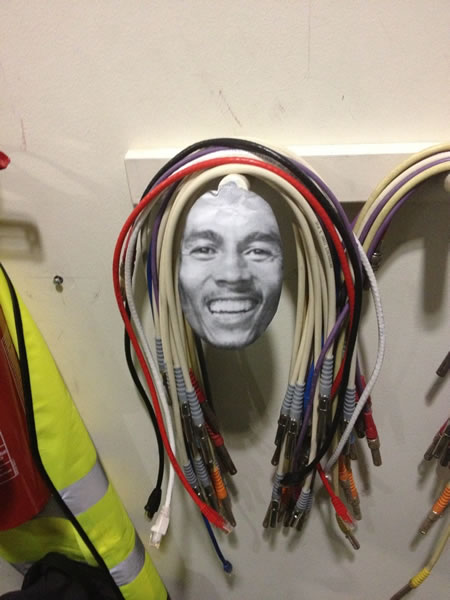
Better cable management with Bob


Seen at Boing via globalnerdy

Omnichord, Casio and Mochika into my Kaoss Pad


Hooked up my circuit bent omnichord and Casio with my Mochika and triggered samples recorded on the Kaoss Pad.

The audio is clipped, so turn down your speakers a bit. Below is a sketch of the set-up I did for the sketchbook diary I've been keeping this year. There's more of that on my other blog.

Bloody Good Time


Remix number eight this month is Bloody Good Time by What Would Iggy Do?, which I found listed as part of a remix competition.

My version channels some Sigue Sigue Sputnik, who were an '80s cyberpunk sorta electronic rock band. They may have looked like a Blade Runner dress-up party but their music is sometimes cool.


It was refreshing to have so many tracks of great performances, as well as many percussion sounds. The bass sound here is mostly Reactive once again and I've edited the vocal because there were lines I liked better than the chorus but I struggled with the backing vocals a bit too.

New mix from Four Tet


Different vibe to Conference of Birds, more soothing but still full of childhood nostalgia, jazzy touches and dreamy vinyl ambiance.

Hipster music manifesto

Dubtherapy Green Orbits remix


Just occurred to me that the dubstep direction of that wristwatch remix was probably the result of this remix I've been working on. Above is the track Green Orbits by Dubtherapy, who are holding a remix competition at present.

Here is my second attempt at remixing the track. I liked the piano and reverb decays but thought it lacked the dubstep of the original.


Below is my third attempt at remixing the track. You can guess I was trying to put the dubstep into the remix. Tried editing different parts from different remixes together but in the end this just jumps out as it is. Could've edited it a bit more but it's time to move onto another remix.

Disquiet Junto: wristwatch dubstep


Project brief


Disquiet Junto Project 0056: Matter of Time

This week's project requires you to make a field recording to serve as the source audio. These are the steps:

Step 1: Locate a clock that has an audible, even if very quiet, tick to its second hand. A watch or other timepiece is also appropriate to the task.

Step 2: Record the sound of the clock for at least 30 seconds, and do so in a manner captures the sound in the greatest detail. A contact mic is highly recommended.

Step 3: Adjust and otherwise filter the recording to reveal the various noises that make up its tick. The goal is to get at the nuance of its internal mechanism.

Step 4: Create an original piece of music employing only layered loops of that sound. These layered loops can individually be transformed in any manner you choose, but at least one unaltered version of the original recording should be included in your piece.

Deadline: Monday, January 28, 2013, at 11:59pm wherever you are.

Length: Your finished work should be between 2 and 5 minutes long.

[...]

More on this 56th Disquiet Junto project at:

http://disquiet.com/2013/01/24/disquiet0056-matteroftime/

More details on the Disquiet Junto at:

http://soundcloud.com/groups/disquiet-junto/


Project account

Before I could begin remixing, I had to search for a timepiece.

This Fisher Price clock was the only thing I could think of in our house.


Luckily my son had been given a wristwatch recently, so it still had a battery. I experimented with different positions on my best contact microphone, settling on direct application with the clock mechanism.

There were two really good recordings in the end. I put the following one on Soundcloud and began remixing the other one, which sounded a little deeper. I can't really hear much of the mechanism but it does seem like the seconds tick with a subtle modulation that I imagine sounds like the turning wheel.


Often I'll be remixing a track and evolving the samples in a certain direction and find I get tired of it, so I'll begin again with a clearer idea of what sounds I can get from the samples. Today was one of those occasions.

The kick drum took a little bit of time to adjust the pitch and compression to get a suitable thump and then adjust Ableton Live's beatrepeat effect to get the rhythm right. Then I adjusted loops, setting their speed to varying sizes and adding beatrepeat and other modulations, reverbs and echoes.

The shape and structure was largely done when I realised I wanted a bassline to counterpoint the kick. After adjusting a short loop so two clicks sat over the beginning and end of the sample, I experimented with the Ohmboyz delay I often use for bass sounds. Then I remembered the Sinevibes plug-ins I'd bought before Christmas, settling on Reactive.

That bassline isn't just that one effect though, there are saturation and distortion effects before beatrepeat, as well as limiting, compression, delay and another filter. Anyway, once I heard that I knew the track needed more of a dubstep sorta flavour, so I mucked around with more beatrepeat and Reactive to get minor note changes and added more glitchy sorta effects, including some made by Audio Damage. Yohng's W1 Limiter is used on tracks and the master buss.

New Bonobo


Sounds great, looks amazing too. Download the new single Cirrus for FREE at bonobomusic.com/

Naive Machine album


Enjoying this this morning

JBroid Pink Death Coronial Inquest mix


Above is Pink Death by JBroid, who have made the track available to be remixed so I had a go this morning.

Technological mandala


Beaut mandala by Leonardo Ulian.

Nils Frahm's Re (Bassling's ray mix)


Disquiet Junto Project 0055: Two Screws

  This week's project involves a shared set of source material. The source audio is the free solo piano album 'Screws' by Nils Frahm. 

  Frahm, who's based in Germany, posted the nine-track album of short solo works for free download while he was recuperating from busting one of his thumbs. He subsequently created a site to house all the remixed/reworked versions that admirers sent to him, as well as the videos and other responses that he received. 

For this project you will take two of the source tracks — "Do" and "Re" — and create a new track from them, in the process creating a work for two pianos. 

Source Audio: You can download the files as sets of MP3 or AIF audio: http://public.erasedtapes.com/screws/ERATP046_Nils_Frahm_Screws_mp3.zip  http://public.erasedtapes.com/screws/ERATP046_Nils_Frahm_Screws_aif.zip

Or download the individual file directly from their links here:  https://soundcloud.com/erasedtapes/sets/nils-frahm-screws

You can only use those two Frahm tracks as audio source material for your track, and you cannot add anything other sounds, but you can transform the two Frahm tracks as you please. In the end, though, the sound of a piano should be evident.

  Deadline: Monday, January 21, 2013, at 11:59pm wherever you are.

Length: Your finished work should be between 2 and 5 minutes long.

  Title/Tag: When adding your track to the Disquiet Junto group on Soundcloud.com, please include the term "disquiet0055-twoscrews" in the title of your track, and as a tag for your track.

Also: Be sure to share the track to the Reworked site, here: http://reworked.nilsfrahm.com/submit/ 

Linking: When posting the track, be sure to include this information:

More on this 55th Disquiet Junto project at: http://disquiet.com/2013/01/17/disquiet0055-twoscrews/

More details on the Disquiet Junto at: http://soundcloud.com/groups/disquiet-junto/

More on the Frahm project at: http://reworked.nilsfrahm.com/


For this project I explored the 'follow' function in Ableton Live, setting short loops to play 'any' following and sat back to enjoy the random harmonic collisions that ensued.

After limiting myself to samples from the track 'Do' and not finding a satisfying combination, I experimented with 'Re' -- which is a really lovely tune and I didn't think I could add anything to it.

Inspiration for this remix comes from Susumu Yokota, whose loop-based work I've enjoyed. Brian Eno also for the interesting phasing that results from the few pitched loops that I've used.

The phrases I've used were about seven semitones apart and one is slightly short. Aside from the reverbs, effects include Ableton Live's Beatrepeat to isolate notes from the piano playing.

It's cool to see Nils Frahm encouraging people to re-work his material. While looking for his version of Re to share here I found the following video using it.

(Re)flection - a Nils Frahm rework from Jem the Misfit on Vimeo.

Tape Bow Violin

Schemawound's Dawn (Bassling's dub)


As well as challenging me, the Disquiet Junto has introduced me to a wide variety of musicians and producers.

Schemawound is one such artist and, when I saw he was soliciting remixes, I put my hand up to rework one of the tracks on his album They Want To Make Your Body Move. I Want To Hold You Perfectly Still.

The track Dawn above caught my attention while listening to this album, something about the tones and textures reminded me of 'The Wires' and made me think about phenomena related to sunrise.

I've called this a dub rather than a remix because I haven't edited it at all. What I have done is reverse the track, duplicate it and put one version up a couple of octaves and the other version down a couple, then gate both using Ableton Live's Beatrepeat and add a bunch of delays and reverbs and glitchy effects as well as a very simple kick and snare rhythm. There's a click-y sorta percussion that's the result of compressing the gates and normally I'd try to avoid this but thought it worked.

Edit: Out now on Schemawound's Body Movements remix album with a great variety of artists bringing their sounds and interpretations.

Encouragement to become a cyborg


Fascinating talk from a colour-blind guy who uses technology to hear colours and has explored a variety of ways in which to represent sound through colour based on his experience of substituting sound for colour.

Ice cube remix


Disquiet Junto Project 0053: Ice for 2013

Happy new year! This week's project is as follows:

Please record the sound of an ice cube rattling in a glass, and make something of it.

Background: Longtime participants in, and observers of, the Disquiet Junto series will recognize this single sentence as the very first Disquiet Junto project, the same one that launched the series on the first Thursday of 2012. Revisiting it a year later provides a fitting way to begin the new year. A weekly project series can come to overemphasize novelty, and it's helpful to revisit old projects as much as it is to engage with new ones. Also, by its very nature, the Disquiet Junto suggests itself as a fast pace: a four-day production window, a weekly habit. It's beneficial to step back and see things from a longer perspective.

Deadline: Monday, January 7, 2013, at 11:59pm wherever you are.

Length: Your finished work should be between 2 and 4 minutes in length.

[...]

Linking: When posting the track, be sure to include this information:

More on this 53rd Disquiet Junto project at:

http://disquiet.com/2013/01/03/disquiet0053-ice2013/

More details on the Disquiet Junto at:

http://soundcloud.com/groups/disquiet-junto/


I wasn't looking forward to turning off the airconditioning so that I could record an ice cube with a forecast maximum of 42C (it reached 44.8C). The cube itself was larger than normal, which helped but was the result of not being able to locate the ice cube tray.

It's becoming something of a habit for me to misinterpret the instructions for the Disquiet Junto projects and for this one I initially set about recording the ice cube in different cups using a contact microphone. I was amazed that I could still hear the kids playing outside in these recordings. Four different cups were used, one plastic and the others glass -- including a nice crystal wine glass.

After realising I was drifting away from the instructions, I set up my stereo mic and made recordings of the ice rattling in three different glasses. I also recorded video with a view to making a clip to accompany the track but I think that might be another project.

Once I opened the files in Ableton Live I made a few different tracks before settling on one to submit. This was also my experience remixing playgrounds. I found I'd make one or two very loop-y rhythm sorta tracks before getting the ideas to make something more harmonically interesting. (Not that this track is particularly harmonically interesting but it's got a couple more chords than the earlier drafts.)

The track Solitary was titled because I could imagine it as the soundtrack to solitary confinement in a freezing cell. It uses four samples, one of the plastic cup with the contact mic and two other cups recorded with the stereo cardioid mic. The chime-like sound comes from the wine glass.

The kick drum sound is a drip from the ice hitting the bottom of the plastic cup, pitched down two octaves. The other samples were ice rattling in a glass, pitched down between half to two octaves. Gating and EQ were used to bring out the sounds I wanted and remove hiss. The kick sound has a springy sorta reverb, other samples have bigger decays.

P.S. My sketchbook diary entry shows a little of this project.

Squidfanny's Alesis HR-16


Posting this because I can see myself watching this beaut jam a few times. Lovely work on the Alesis drum machine, enjoying the squealchy sounds.

2012 in 60 seconds


One of the highlights of 2012 has been getting involved with the Disquiet Junto project, who this week posed an interesting exercise.

I've selected 12 five-second segments of recordings from throughout the year based on when different files were exported (which seems to be a bit different to some of the links below).


Here's some context for each section:

January
The year opened with me procrastinating on finishing my album For 100 Years, which ended up being released in July. On the day of internet protests about the SOPA I remixed a video which Google had alerted me to because it had something resembling Bassling in the title. It gave me a big buzz when the guy I remixed saw it.


February
This track was my third attempt at remixing Waipukurau Park and had been mostly completed in December when I edited the video but my files show I worked on it around this time although it probably wasn't finished until closer to July.


March
It's been maybe three years since my cousin Chris died but I still think about him often and this track is one example. Early in 2012 I had the idea of recording an EP of solo bass and I'd been thinking about Chris because he helped me buy my first bass and encouraged me to play it.


April
This comes from a short mix of Skunkhour tracks I put together around the time I posted about the mix of INXS tracks I made for the project, which was more popular so I'll post the video I made for it here.


May
A recording of a jam on circuit bent gear and guitar pedals that I titled as an Outkast cover on Youtube.


June
Another jam with circuit bent gear and guitar pedals, as well as bass and theremin.


July
2012 was a milestone year as a musician for me and this was a great month with the release of my fourth, fifth and sixth albums.


As well as a great article on my album in a national magazine, I was invited to improvise with some great Wagga Wagga musicians.


August
Finally able to distribute the mammoth three-hour immersive audio recording of 'the wires' I'd finished in 2010. Dunno what people will make of it, I deliberately didn't master it so that it'd be background noise but that's probably part of how I experienced this otherworldly instrument.


September
A recording of a Fisher Price clock using my new contact mic.


October
This Dinosaur Park remix was one I mastered for...


November
Another 100 Years, an EP of remixes I released to coincide with my exhibition, which followed on from the album. The track heard here is actually the first park remix I made at Waipukurau Park in 2011.


December
Seems I'm back in a slump again but hope to finish my For 100 Years DVD. The audio here comes from one of the remixes I'm working on using the DVD cover/instrument developed for the release.

Great mixes of 2012

Here are some of the mixes I've enjoyed this year:
  1. Four Tet's Conference of the Birds -- also this mix from Boiler Room
  2. Doc Delay's Beastie Boys Tribute mix -- also this Paul's Boutique mix
  3. Tom Bonaty's Smoke Machine podcast
  4. Stompin' To The 90's by Long Distance Dan
  5. Nadja Lind's Chillout Dub Mix 
  6. Headphone Commute Back to Mine Mix
  7. DJ Rupture's Change the Mood mix
A late contender is Old Apparatus' PlayGround mix, which is pretty great too. And I also like Jamie XX's Boiler Room mix.

And I've been enjoying revisiting a bunch of great artists via the mixes at http://hurroooooooo.blogspot.jp/ -- particularly the Plaid, Aphex Twin and Luke Vibert.

Happy listening in 2013!

More from a long time ago, in a galaxy far far away


Spotted a couple more boutique pedals on Ebay this morning from the guy inspired by Star Wars who I mentioned earlier. These are the Rogue Leader above and the Thermal Detonator below.

July August September October November


Disquiet Junto Project 0050: -…….–.-..-…-
This week’s project explores invokes Morse Code for its rhythmic content. The instructions are as follows: Select a word or phrase. Encode that word or phrase by the Morse method. Record a rhythmic foundation in which the dash is represented by a long beat and the dot by a brief one. Use that rhythmic foundation as a loop for the length of your track, at the speed you desire — speed can vary over the length of the recording. Record accompanying drone/melodic material that takes the underlying rhythm as its compositional foundation.
Deadline: Monday, December 17, at 11:59pm wherever you are.
Length: Your finished work should be between 1 and 3 minutes in length.
Information: Please when posting your track on SoundCloud, include a description of your process in planning, composing, and recording it. This description is an essential element of the communicative process inherent in the Disquiet Junto.
Title/Tag: When adding your track to the Disquiet Junto group on Soundcloud.com, please include the term “disquiet0050-morsebeat” in the title of your track, and as a tag for your track.
Download: For this project, your track should be set as downloadable, and allow for attributed remixing (i.e., a Creative Commons License permitting non-commercial sharing with attribution).
Linking: When posting the track, be sure to include this information:
More on this 50th Disquiet Junto project at:
http://disquiet.com/2012/12/13/disquiet0050-morsebeat/
More details on the Disquiet Junto at:
http://soundcloud.com/groups/disquiet-junto/


This track began with Jason, both as the author and the Morse Code beat thumping throughout:
J A S O N

You'll hear this joined by a drone and then broken beats and some echo on a synth playing the intro to a Black Sabbath tune, then it drones a bit more and ends.

Holy Fuck, a band I'd like to see live

Nice work from Frankenmusik


Like the look of this new creation from Frankenmusik that's on Ebay right now.

Circuit bent omnichord


Bought this circuit bent Suzuki omnichord recently and am trying to avoid the cheese by using the MIDI.

One of the cool things about omnichords is the way they get you thinking about minor and seventh chords. I also like how the MIDI outputs on three channels with the strum notes, a three-note chord and a bassline.


Edit: Found this video of another circuit bent omnichord.

I heard he's in a metal band

Like this image from Bwana Spoons because I've always wanted to be in a metal band :)