Redacted Disquiet Junto

  Disquiet Junto this week is an open-ended exploration of surveillance and graphic notation.

The image presented is page 8 of recently declassified documents related to NSA collection of telephone metadata records.

It's became the musical score for this piece I recorded using a Casiotone MT-36 circuit bent by Frankenmusik, a kick drum and my voice.

I considered recording this interpretation in the opposite direction to the score as a form of protest to the widespread surveillance being reported since Edward Snowden's brave decision.

The Junto is an opportunity for me to try something different so I decided to record live because I liked the idea of events happening in real-tiem being recorded. Then I cast my mind about for suitable instruments.

It had to be something quick and dirty, the score was rough and black but the content was human. So there needed to be a vocal and the time signature was suggested by the page number, although I wasn't too strict once it started.

I like the sound like a dot matrix printer, it's dated but seems apt for a government record.


Current set-up


This weekend I'm making acid, driving basslines from the Mochika and looping snippets of crunchy circuit bent beats from this diabolical Yamaha device. Enjoying it so much I might not get around to recording the Junto piece that's losing my attention.

Disquiet Junto Minimal Haydn


This week's Disquiet Junto proposed a minimal techno remix of Franz Haydn’s String Quartet in F Major.

It took a couple of attempts before I found short loops of a bar or less were best for a techno feel.

The violin sounded a bit like Bernard Hermann's score for Psycho until I threw it down a flight of stairs.

The deep bass runs provided a nice kick sound by looping a small but dynamic section and adding a gate. I re-pitched loops, starting a 12-bar blues riff before it got patchy.

The structure was done on the fly for a live warehouse party in the early '90s-type vibe but the main influence was Ritchie Hawtin's music as Plastikman.

P.S. -- I've revised this remix after listening back and realising the glitch was a bit overdone. It was a sore thumb.

Harrison Young on poetry

Poetry is full of metaphor, and metaphor is where one thing means another, it is saying two things at once. And this to my mind is like reality, there are often two aspects. Or more.

Disquiet Junto Cheap Generative


This week's Disquiet Junto is based on a four-loop composition, specifically one 2 seconds in length, one 3 seconds, one 5 seconds, and one 7 seconds long with a 3-second pause to one of the elements and a 1-second pause to another of these elements.

The material comes from a recent collaboration and it was challenging settling on the final loop. The bass and bell-like pipe were given but I spent a while trying out other loops. I also cheated a bit I think, the loops length mightn't all be strictly following the rules.

It was an interesting approach to composition and one I'd like to try again. I like writing haiku for the framework and this offers a similar set of rules but I'd probably shorten it.

Kinda reminded me of John Cage:
In Zen they say, 'If something is boring after two minutes, try it after four. If still boring, try it for eight, 16, 32 and so on. Eventually one discovers that it is not boring at all, but very interesting.

Recent collaboration


Another result from my community recording sessions during the school holidays, this time in and around Leeton's Mountford Park.

The pipe organ sits in a church just across the road, so I bent the rules a bit but it really deserved to be part of the track as it's also celebrating a centenary. And I love pipes, so it was an opportunity to hear how it sounds without sitting through a sermon.

Thanks to local maestro Dominic Vella for the melody and thanks to the kids who joined in too.

PS -- Nice follow-up piece in The Irrigator today

Karl Bartos' purity

When I was young and studying music, like most music students of the time I was into Jazz. My professor once said to me, 'Why are they playing so many different notes? They're searching for the right note.' So I have nothing against improvisation but I'm more into defining what note I want to have. That's why I've always been keen on visual pictograms, like traffic-signs as its pure information. If you can find a chord progression and a pure, authentic melody it's all you need. The most important information is definite pitch because it's the purest information our brain can remember. That's why everyone can remember so many different melodies.

Beatreport


After having a laugh and then shaking my head about this post on the homogenous sounds in Beatport's EDM chart, one talented producer whose work appears on that service pointed me toward the video above. Ha!

More Dinosaur Park


Think I should call this track 'Having a Barney' for the role of the purple dinosaur. As mentioned elsewhere, this song is one of many remixes made from playground recordings. I'm really keen on this Belgian producer's take on the material:

Screenings


Tonight was the last of the three screenings. Mountford Park looks magic at night and tonight it sounded magic too, as the church bells chimed six o'clock during one of the Mountford remixes.

The response was positive and it was satisfying to see my work projected large.

From last night's screening


This is one of the videos I've made from the community recording sessions held last week. It was screened on the water tower in Leeton's Central Park last night.

Playground recording workshop


This month I'm revisiting my project remixing Leeton playgrounds for the centenary, as it's closing and I wanted to give my videos a local screening before they join Albury's urban art programme in August and September.


I promoted that people could come and record with me and appear in the screenings. The first recording session was in Central Park on Monday and I was joined by about half a dozen with three kids taking an active interest.


They encouraged me to try the contact microphone on a couple of things I hadn't tried, such as listening to my pulse and recording the water tower in the park. It was really gratifying to see how enthused they were about the sounds and their potential. The youngest at one point exclaimed there were hundreds of sounds to discover.

New Mountford Park


A lot has changed in the park at the heart of Leeton, so I returned last Sunday with my contact mic and camera to hear how the new flying fox and basket swing sound. This is my first go at using the samples.

Teaser


This video features percussion isolated from the track below. I'm working on a full video that will debut at the screenings I'm organising in Leeton next month.

Ableton Live has this FANTASTIC feature where you can manipulate the audio of video samples as easily as just audio and then export video with basic edits. I think they updated the codecs it'd accept in version eight but it still seems limited to standard definition, which is a great start. I'd really like to see them improve what the program will export, such as reversing footage when this is done to the audio.

Number five is alive

Dinosaur Park


Here's an early experiment with material recorded at the park my kids have named for the purple dinosaur. I'm working through my park recordings and generating new material to screen next month. This is okay, I've already got a couple of reservations but I've also already got another remix underway too.

Below is a remix of Dinosaur Park in a techouse style from a talented Belgian producer.

Waipukurau Park


Knowing that my neighbour Corey plays drums, I invited him to try playing our local playground. He settled into a rhythm on the slide and then experimented on the fence around the child care centre. I've looped parts of the former and added a slowed-down section of the latter.

Borrowed dream


The Disquiet Junto this week was a challenge for me, because (a) I don't usually remember much of my dreams (which is good because they often seem to involve my kids falling to their deaths) and (b) my room is very quiet aside from the noise of my daughter usually stumbling in around 1AM. So I borrowed my youngest's dream and added a few effects.

I like that it's a running dream. Many dreams I remember from my childhood involved running from things.

Playground magic


Been revisiting my recordings of Leeton playgrounds and remixing them again but this recording seemed interesting enough without treatment. My plan is to screen a short presentation in a couple of parks this July to mark the anniversary of the For 100 Years album, the closing of town's centenary and to collect together new material that will appear on the DVD I'm finally going to finish.

This recording was made at Gossamer Park, which benefits from being one of the last parks I recorded. I used two types of piezo contact microphone, on the left channel is my homemade one and on the right is the cheap clamp-on variety. There's a little EQ but otherwise no further production.

Below is the mastered version, which sounds massive.

Return to Central Park


After the Junto, I returned to samples of Leeton's Central Park, last heard closing For 100 Years. It's been about a year since I manipulated these recordings and it's interesting returning to find new possibilities but I'm looking to record there again in July too.

Junto clap remix


This week's Disquiet Junto involved recording clapping and remixing applause. It's another interesting exercise in revealing how different people approach the same material because claps seem to produce very similar transients, so everyone is almost using the same ingredients.

To record my clapping I used a Rode NT1 with an Audio Technica AT4040 (I think, it's the cheap version of that model) in an XY position. I thought it would be interesting to compare these two mics as I don't use them much and was thinking of Ebaying them. The NT1 is a bit brittle and the AT4040 is kinda quiet but the waveforms showed quite a bit of difference between the two, although my ears didn't register much as the placement of my hands varied the results more.

It was interesting to experiment with hunching over the mics to get more lower frequencies reflected around them and leaning back to get more attack with the reflections from the roof. I think this was the case, I was also extenuating the treble in the slap at the time too.

Manipulating the recordings in Ableton Live led me to loop a couple of claps, vary the loop placement and then have them follow each other with a bit of a Beat Repeat effect. It sounded like I couldn't clap in time for a while but eventually I got a minimal percussive part going and lost interest. At this point I often think it's best to start afresh with a clearer idea of what results can be achieved, but instead I continued.

Returning to the track I sought to develop a harmonic progression but the short transients wouldn't give me much joy. Then I remembered the Sine Vibes plug-ins and used a few of their presets. After that I arranged those parts, added some dynamics with effects and mastered.

My clap trap


faultynotation

The Disquiet Junto this week was an interesting exercise involving interpreting a map as a score.

It stumped me but I was also preoccupied with another project too. Eventually a modulated high-hat kept coming into mind and this kinda directed the result because I settled on using samples from an old song with a similar sound called Slow boil with a few soft synths too.

And then I thought it needed to sound gritty and earthy.

Around the house


This week's Disquiet Junto was a return to remixing field recordings and, because the instructions referred to both knocking (here on doors and windows) and a microwave, I used these along with a looped voice. I unfairly identified my kids as an intrusion, so you can hear my eldest playing Zelda and then the others knocking on the door. I won't complain but it's been a long week.

Sense the wind


This morning I scored the trailer above for this week's Disquiet Junto project.

Sorry for the quality of the sounds, I composed and produced this in under three hours while I had a little time to myself. The clean guitar part heard halfway and at the end would've been a synth, if I'd had a bit more time.

When I saw the trailer I thought it looked like a human interest story until I considered how exhilarating racing on water must be. Then all I could hear was big drums with a Rage Against The Machine-style guitar riff, the latter played through my Giant Cooter.

Simply sublime


Was reminded of the Aphex Twin piece above when Tim posted this Steve Reich recently.

Disquiet Junto Nofi Thriller


Wow, the live session by Jeffrey Melton that my collaboration above comes from is really something else. Read the Disquiet Junto info for the link. I thoroughly enjoyed listening to it today and spent a lot of time playing bass along to it. It was difficult to settle on a section to record but thought this bassline had more variations than the others.

While playing bass to the Nofi recording, I rediscovered that it's a great instrument for implying chord changes by shifting root note. So I jammmed from F# into A, D and E, ending up with the riff I play after Thriller drops.

There's an overdubbed bass at the beginning that's repeated later. I was trying to come up with a melody but thought these notes sounded like Tortoise. It's a bit muddy but hopefully adds more interest.

P.S. -- Have a listen to the drumming Lee Rosevere has added to this posthumous collaboration. Wow!

Here's the Drop

Hahaha Happy April Fools Day Soundcloud :)

Disquiet Junto Tosca accoster


The Disquiet Junto this week takes the regular Soundcloud picnic to a whole new level. Read the Disquiet site description for details of the piano overlay exercise, the 65th Junto project.

I've been involved in more than a dozen projects now and there were a few others that I misinterpreted that were interesting experiences for me too.

When I first listened to Jared Brickman's piece I was reminded of Tosca, the Austrian downtempo electronica duo of Richard Dorfmeister and Rupert Huber. Particularly the disc of piano recordings that came with their Delihi9 album, I think.

Since I spent Good Friday afternoon playing bass and kick drum, I was feeling kinda groovy by the time I'd put my kids to bed and started working on my composition.

After a little bit of time jamming along with Jared, I settled on the two bass parts and looped them to accompany a drum beat straight out of the Audio Damage Tattoo presets.

Then I experimented with effects and EQ to shape the piano and bass and make space for each, before creating another percussion part.

Then more experimenting with effects, like amp simulators and modulators, to keep it interesting and moving along. I'm not sure what the sound is that comes in around the two-minute mark, the growling drone in the mids that starts to hum like reverb feedback or something but I really like it. Reminds me of 'the wires'.

Anyway, when I returned to my project on Saturday morning I was very happy with it and got to work on the final export. I'd been working with headphones last night so it was good to hear it on my monitor speakers and add some polish with my UAD effects.

The phasing on the percussion in the section where the piano is gated and delayed gives me a good feeling but overall I'm super happy with my contribution and reckon I got a good Dorfmeister-style dub bassline going on.

Re-Endtroducing


This is a great homage and a great way to revisit a classic modern album, DJ Shadow's Endtroducing. Read about it here.

50 Shades of Decay


Got one of my new tracks using circuit bent instruments on this compilation from US-based netlabel Waxen Wings.

The opening tracks are OTT but there are a number of good tunes on this album and I like that's there's another Diabolical Device, which is the name of the mods on the Casio I used too.

Disquiet Junto School bus Friday pm


Disquiet Junto Project 0064: Composing from Memory

This week’s project's theme is composing from memory. It is recommended that you read through all the steps in the project before proceeding to attempt to execute it.

These are the steps:

Step 1: Find a place, preferably outdoors, where you can sit for five to fifteen minutes without being disturbed. This place should have a fair amount of inherent noise to it, and that noise should be variable, not static — i.e., not the long held drone of an overwhelmingly loud HVAC system, but the bustle of a street corner, or of a playground, or, if weather or other circumstances keep you indoors, perhaps of a busy cafe.

Step 2: Bring with you a portable recording device as well as something on which you can quietly take a small number of written (or typed) notes. You may wish to do a test recording to be certain that your note-taking isn't part of the audio recording.

Step 3: Settle into the space and get a sense of its sounds. Listening closely.

Step 4: Make a field recording of one full minute, or a little longer, of continuous sound in this place. While recording the sound, use time codes to make note of any memorable sonic instances.

Step 5: Trim the field recording to exactly 60 seconds.

Step 6: Without listening back to the field recording, compose and record a 60-second piece intended to complement it. Refer back to your time-code notes to align composed instances with those real-world instances that you recall having distinguished your field recording. You can use whatever instrumentation you like, but it is recommended that you use no more than one or two instruments. You should not employ any field recordings in your composed piece.

Step 7: When your composed piece is completed, layer the two tracks together into one new 60-second work. They should be played back at equal volume, more or less. You can adjust a little to achieve the impression of balance between the field recording and the composed work. The only editing you can do is to fade in and out, if that is so desired.

Deadline: Monday, March 25, 2013, at 11:59pm wherever you are.

Length: Your finished work should be 60 seconds long.

Information: Please when posting your track on SoundCloud, include a description of your process in planning, composing, and recording it. This description is an essential element of the communicative process inherent in the Disquiet Junto.

Title/Tag: When adding your track to the Disquiet Junto group on Soundcloud.com, please include the term “disquiet0064-halflive” in the title of your track, and as a tag for your track.

Download: Consider setting your track in a manner that allows for attributed, commerce-free remixing (i.e., a Creative Commons license permitting non-commercial sharing with attribution).

Linking: When posting the track, be sure to include this information:

More on this 64th Disquiet Junto project at:


More details on the Disquiet Junto at:


- end -


Soon after reading the Junto email I concluded that recording the school bus stopping outside my house on Friday afternoon would be a good field recording, for convenience as well as interesting material for my Rode NT4 stereo microphone.

Bass guitar was also settled on for convenience, as I've more experience on that instrument and I could use a light semi-acoustic model to spare my aching back.

After hitting record when the bus entered my street, I scribbled a few notes while watching the time on my Zoom H4. I can hear my eldest comment on seeing me but he decided not to try and get my attention. The 60-seconds ran out just before my daughter walked up to the microphone and asked what I was doing.

At first I wasn't sure what key to use, the bus sorta sounded like a D or maybe I just associate that low pitch with D. Anyway, I thought I'd pick something that wasn't D in case it clashed, remembering this riff using a C 7th (I think).

The idea was to progressively pick up the pace as the bus stops and the kids excitedly enter the scene, then I thought I'd ramp it up a bit more with the slapping while the bus roars away.

Disquiet Junto: Greg or Ian at the Park


Disquiet Junto Project 0063: Gregorian-orian-ian

This week’s project involves the role of architectural spaces in the composition of music. It is a shared-sample project that takes a piece of Gregorian chant as its source material.

These are the steps:

Step 1: Download this OGG audio file that contains a recording of monks singing Gregorian chant at the Abbey of Sant’Antimo in Italy:


Step 2: Play back that recording loudly in a highly reverberant space and record it. Your best bet may be a bathroom.

Step 3: Create a new piece of music using the recording you just made as your primary source material. You cannot add any new source material. You can manipulate the audio recording as you please, but restrict yourself to effects that simulate echo, such as delay, reverb, and looping. You may also use the original OGG file, but only in addition to your own recording of it being played back in the reverberant space.

Background: For additional thinking on the role that architecture has played in the evolution of music, this 2010 talk by David Byrne is recommended:


Deadline: Monday, March 18, 2013, at 11:59pm wherever you are.

Length: Your finished work should be between 1 and 4 minutes in length.

Information: Please when posting your track on SoundCloud, include a description of your process in planning, composing, and recording it. This description is an essential element of the communicative process inherent in the Disquiet Junto.

Title/Tag: When adding your track to the Disquiet Junto group on Soundcloud.com, please include the term “disquiet0063-gregorianorianian” in the title of your track, and as a tag for your track.

Download: Consider setting your track in a manner that allows for attributed, commerce-free remixing (i.e., a Creative Commons license permitting non-commercial sharing with attribution).

Linking: When posting the track, be sure to include this information:

More on this 63th Disquiet Junto project at:


More details on the Disquiet Junto at:


The source of this piece is a recording of monks singing Gregorian chant at the Abbey of Sant’Antimo in Italy:


- end -


On Friday afternoon I considered cranking the monks and recording them reverberating in my bathroom but I didn't get to it before my kids returned from school.

So I thought the drains at the park might be interesting, putting my 3V sound system at one end of the storm water drain and my Rode NT4 stereo mic at the other.

The noise from the nearby rice processing facility added a nice low rumble and there were some birds chirping too, a bit of a fail in terms of ensuring fidelity to the sound source.

The results were okay but I wanted more of those resonances that really warp the frequencies out of proportion.

I returned to Waipukurau Park on Saturday to try resonating the monks on the metal slippery slide.

This slide has featured in a song I composed with the Park, as has the nearby metal fence of the Leeton Childcare Centre -- which sounds fantastic.

The 3V sound system was placed facing down on the top of the platform on the slide, with a contact mic was affixed halfway along one of the legs which support it.

The results showed more exaggerated frequencies but was a bit weak on its own.

In Ableton Live I put recordings from both locations together, finding them stretched for some reason. I added additional tracks, delayed a few seconds and then experimented with effects including phase, the vocal-doubling preset on a tape emulator and church-style reverbs, settling on a wooden one.

Return to the fence

Went down to the park today to record some material for the Disquiet Junto this week. Disturbed a large group of ibis.

While I was there I decided to revisit the Leeton Childcare Centre fence, which featured in the Waipukurau Park track on For 100 Years.

I've posted a recording of this fence previously.

Methinks, it should have been impossible
Not to love all things in a World like this,
Where e'en the Breezes of the simple Air
Possess the power and Spirit of Melody
-- Samuel Coleridge

How to write electronic music


Tom Cosm produces cool psytrance and makes excellent tutorial videos for Ableton Live. I liked his previous ebook on creativity so I thought I'd share this forthcoming title.

100 years of noise


Create Digital Music has a piece on the anniversary of Luigi Russolo's Art of Noises manifesto, which surprised me to see it shares the day with the centenary of Canberra where I was born.

Thought a remix was in order and I've been admiring the sounds from this monument since Vic McEwan mentioned it a few weeks ago. Vic's developed a keen interest in contact microphones over the last year and, as well as asking about my techniques, has put forward the idea of us working together, which would be a great opportunity to share skills and ideas.

Disquiet Junto: Sine of the times


Disquiet Junto Project 0062: Life of Sine

This week's project involves making music from the basic building block of sound: the sine wave. 

You will compose and record a piece of music using just three different sine waves, and nothing else — well, nothing else in terms of source material, but the waves can, after the piece has gotten underway, be transformed by any means you choose. 

These are the steps:

Step 1: Devise which three sine waves you will employ. They should be different from each other in some evident way.

Step 2: The track should open with just one of the sine waves. 

Step 3: Add the second sine wave at 5 seconds. 

Step 4: Add the third sine wave at 10 seconds.

Step 4: Only at 15 seconds should you begin to in any way manipulate any of the source waves.

Deadline: Monday, March 11, 2013, at 11:59pm wherever you are.

Length: Your finished work should be between 1 and 4 minutes in length.

Information: Please when posting your track on SoundCloud, include a description of your process in planning, composing, and recording it. This description is an essential element of the communicative process inherent in the Disquiet Junto.

Title/Tag: When adding your track to the Disquiet Junto group on Soundcloud.com, please include the term “disquiet0062-lifeofsine” in the title of your track, and as a tag for your track.

Download: Consider setting your track in a manner that allows for attributed, commerce-free remixing (i.e., a Creative Commons license permitting non-commercial sharing with attribution).

Linking: When posting the track, be sure to include this information:

More on this 60th Disquiet Junto project at:


More details on the Disquiet Junto at:


- end -


One observation about the Junto this week, going into it I had no preconceptions about the process but it was soon decided when I started googling to find which audio application I own would produce sines. The results for Ableton Live included a tutorial on using gated sines, which was how I went about covering Prince's 'Sign o the times' since I was short of ideas beyond wordplay. I had to use Soundtrack Pro to make the sines though.

I hadn't used a sine in a production since Postal about a decade ago, despite hearing great applications for adding low frequencies under samples. They're very effective. This was an interesting exercise because I came to conclude that sines only sound great in some keys, particularly F, C and G. Dunno why but these were the tones that made me feel best, maybe it's something to do with the relationships between notes? (Now I think about it, maybe it's the room I'm in?)

The three sines I chose to work with were 43 Hz, 71 Hz and 77 Hz, which weren't such a good idea as these low notes (C0, D# and F) would largely be filtered out before the end of mastering. (Could 43Hz really be reproduced in a room?)

The low note was chosen to serve as a kick drum-essque thump and because it would be easy to put up one and two octaves for the bassline melody, which might work better up an octave

Through trial and error I pitched four other notes, from A3 to D4 with A# and B (233 Hz -- 277 Hz). These form the outline of the vocal melody, which I phase reversed to avoid the muddiness of the mix. Once again I'm thinking I should've tried a higher pitch because these frequencies aren't easily reproduced on some audio systems, like my laptop.

Distortion was added liberally to create higher harmonics on the sines to give them character and to cut-through the mix. The gating was achieved with a MIDI file, I deleted the notes other than the frequency being triggered. I tried vocoding the kick and snare but don't think I did it right, they benefit from reverb and compression though.

Disquiet Junto: Insta/gr/ambient


Disquiet Junto Project 0061: Textinstagr/am/bient

This project requires a single die, or the digital equivalent.

Here are the steps in the project:

Step 1: Roll a die six times (or six dice once), add up the combined results, and then subtract five from it. Make note of the resulting number. If you don’t have access to a die, you can use various digital equivalents. This link, for example, will roll six dice simultaneously:


Step 2: Visit this Twitter account:


Step 3: Count the tweets of that account backwards from the most recent tweet at the time of your visit until you reach the tweet that coincides with the resulting number from step 1 above. Make note of this tweet, unless it begins with an @ sign. If the tweet begins with an @ sign, then use the next tweet (continuing down in reverse chronological order). If the next tweet also begins with an @ sign, then continue until coming to a tweet that doesn't begin with an @ sign. This final tweet will serve as the title of the track you will soon begin composing and recording.

Step 4: Now, roll a die twice (or two dice once), add up the combined results, and then subtract one from it. Make note of the resulting number. This link will roll two dice simultaneously:


Step 5: Visit this web page and locate the list of Instagram filters: 


Step 6: Count down the list of filters on that page until you come to the filter that coincides with the resulting number from step 4 above.

Step 7: Close your eyes and imagine a simple photograph that would be described with the tweet that is the title of your track, and that would have been treated with the filter that resulted from the step 6.

Step 8: Now imagine that the image from step 7 is the cover of your next single. Record a track of original ambient music that would be this single. It should be between one and two minutes in length, true to the postcard-like quality of Instagram — and, by extension, Textinstagram. 

. . .

Background: This project is a low-key followup to the Instagr/am/bient compilation that I developed at the end of 2011, and that was in many ways the direct precursor of the Disquiet Junto. Various contributors to Insta/gr/ambient were among the initial participants in the Junto.

Deadline: Monday, March 4, 2013, at 11:59pm wherever you are.

Length: Your finished work should be between one and two minutes in length.

Information: Please when posting your track on SoundCloud, include a description of your process in planning, composing, and recording it. This description is an essential element of the communicative process inherent in the Disquiet Junto.

Title/Tag: When adding your track to the Disquiet Junto group on Soundcloud.com, please include the term “disquiet0061-textinstagrambient” in the title of your track, and as a tag for your track.

Download: Consider setting your track in a manner that allows for attributed, commerce-free remixing (i.e., a Creative Commons license permitting non-commercial sharing with attribution).

Linking: When posting the track, be sure to include this information:

More on this 61st Disquiet Junto project at:


More details on the Disquiet Junto at:


- end -

I forget what numbers I rolled now but I remember the outcome. The text read:
Girl holding something innocuous just to conveniently show off a little too much boob.
And the filter was:
Valencia Effect: True-to-life contrast, with slightly gray and brown overtones

Originally I thought, stuff it, I'm going to record bowing on a cymbal and say it's whatever seems appropriate because that's what I want to do this weekend.

Well, bowing on a cymbal sounded terrible.

So I thought about the directions I'd been given and decided it needed to be a guitar. It was probably for sentimental reasons because I began playing a riff that I've always liked but never used in a song. It's kinda discordant but I've always liked hearing notes rub against each other.

And I got to thinking about the girl I rubbed against when I played the riff in 1990. Now I've got sore fingers from playing the guitar and a musky smell on my mind.

Dr Blankenstein Illumiringer DIY box


Procrastination is a specialty of mine but after Dr Blankenstein expressed an interest in what I was going to do with his work, I felt obligated to get onto it.

Previously I mentioned plans to install the Illumiringer into a Speak And Spell but I opted to make it a stand-alone effect once I realised it'd be a squeeze to fit the 9V battery into the device. After a bit of hunting around I settled on this plastic specs case to ensure I didn't short circuit anything by using a metal tin.

The effect does control pitch, haven't noticed much character yet so I'll give it a go on my voice sometime.

Spank that tranny


Bet you wish your compressor had 'spank' and 'tranny' options!

Disquiet Junto: vowel choral drone

Interesting exercise this week, requiring recording my voice and cooking it until well drone.
Disquiet Junto Project 0059: Vowel Choral Drone

This week’s project involves the human voice. You will create a choral drone from three samples that you will create with your own voice. This project requires a single die, or the digital equivalent.

Here are the steps in the project:

Step 1: Roll a die three times (or three dice once) to determine which vowels you will use. Depending on your luck, you may end up with two or even three of the same vowel.

1 = A (“a” as in “yay”)
2 = E (“e” as in “bee”)
3 = I (“i” as in “die”)
4 = O (“o” as in “yo”)
5 = U (“u” as in “you”)
6 = Y (“y” as in “Sylvia”)

If you don’t have access to a die, you can use various digital equivalents. This link, for example, will roll three dice simultaneously:


Step 2: For each vowel that you have been assigned by the dice, record a 10-second sample of you holding that vowel as a constant tone (volume, timbre, note, etc.).

Step 3: Create a choral drone that utilizes only these three sources of audio. You can treat them with effects lightly, but they should be recognizable as the human voice throughout the duration of track.

Deadline: Monday, February 18, 2013, at 11:59pm wherever you are.

Length: Your finished work should be between 2 and 5 minutes in length.

Information: Please when posting your track on SoundCloud, include a description of your process in planning, composing, and recording it. This description is an essential element of the communicative process inherent in the Disquiet Junto.

Title/Tag: When adding your track to the Disquiet Junto group on Soundcloud.com, please include the term “disquiet0059-vwls” in the title of your track, and as a tag for your track.

Download: Consider setting your track in a manner that allows for attributed, commerce-free remixing (i.e., a Creative Commons license permitting non-commercial sharing with attribution).

Linking: When posting the track, be sure to include this information:

More on this 59th Disquiet Junto project at:


More details on the Disquiet Junto at:


Using the generator above, it was determined I would work with 'O', 'U' and 'E' sounds. Quickly I settled on singing them as G, B and D -- three notes I like playing with sustain on a piano.

After realising it would be a challenge to sustain the lower note for 10 seconds, I hooked up a pitch-correction pedal to use while singing. Later I realised I didn't use it but I think that thinking it was on helped my performance.

With the samples recorded, I began experimenting with creating a drone and re-pitching the samples to create chords with which to develop a sense of harmonic progression in the track. This became bewildering as I lost track of key and at one point my family began complaining the lower frequencies were making them ill.

The next day I returned to the project and developed a chord progression that would work over the three notes I had. My partner commented that it sounded 'pop' so I didn't worry once it began to take yet another direction when I re-pitched samples.

Think it's finished but I'm not really sure what a 'choral drone' should sound like. On one hand I want it to be choral, so I was conscious of allowing space for breathing, on the other hand I was trying to layer up enough samples to create a drone without relying too heavily on reverb.


Landfill Harmonic


"My life would be worthless without music."

Schemawound's Body Movements


Schemawound's Body Movements remix album features a great variety of artists, including Bassling.

Compilation of Bassling on Soundcloud

Hit play and hear highlights of Bassling's material on Soundcloud, covering nearly nine years of production in a variety of styles from 2004's Postal through to 2013's remixes of an ice cube and a wristwatch.

Around the middle there's ambiance from a large-scale aeolian harp built by Alan Lamb and later there's a techouse remix of a Leeton park from a Belgian producer that I like lots too.

Menage a trois remix

The Disquiet Junto this week was a return to remixing after a sound design assignment last week, which didn't interest me although I made an attempt.

Disquiet Junto Project 0058: Endless Commons

This is a shared-sample project. Create a single new piece of music by employing the selected material (see below) of each the following three tracks. All three were initially released on the netlabel Endless Ascent, and were posted to the Internet with a Creative Commons license encouraging derivative reworking. Please only use this material; you can transform in any way you choose, but do not introduce any new source material.

1: The 30 seconds of “Materia Lucida,” the title track of a release by Kirill Platonkin and Jarguna:

http://www.endlessascent.com/ea023/ea023-Kirill_Platonkin%7eJarguna-01-Materia_Lucida.mp3

2: The second 30 seconds of “With a Wimper” off Exuviae’s album The Sum of Zero:

http://www.endlessascent.com/ea019/ea019-Exuviae-06-With_A_Wimper.mp3

3: The final 30 seconds of “02″ off Illuminoscillate’s album Solar Wave Phase:

http://www.endlessascent.com/ea018/ea018-Illuminoscillate-02-02.mp3

We’re doing this to pay thanks to the open-minded Endless Ascent, which not only releases its music for free download but also employs the Creative Commons license that allows for derivative works. There are hundreds of netlabels out there, but only a small percentage allow for reworking. These occasional Junto netlabel remix projects are intended to promote reworking as itself a means of music distribution.

Deadline: Monday, February 11, at 11:59pm wherever you are.

Length: Your finished work should be between 2 and 5 minutes in length.

Information: Please when posting your track on SoundCloud, include a description of your process in planning, composing, and recording it. This description is an essential element of the communicative process inherent in the Disquiet Junto.

Title/Tag: When adding your track to the Disquiet Junto group on Soundcloud.com, please include the term “disquiet0058-endlesscommons” in the title of your track, and as a tag for your track.

Download: For this project, your track should be set as downloadable, and allow for attributed remixing (i.e., a Creative Commons license permitting non-commercial sharing with attribution).

Linking: When posting the track, be sure to include this information:

This Disquiet Junto project was done as a celebration of the efforts of the Endless Ascent netlabel, and to support its employment of licenses that allow for derivative works. These Junto netlabel remix projects are intended to promote reworking as itself a means of music distribution. This track is comprised of three pieces of music, all originally released on Endless Ascent: “Materia Lucida,” the title track of a release by Kirill Platonkin and Jarguna, “With a Wimper” off Exuviae’s album The Sum of Zero, and “02″ off Illuminoscillate’s album Solar Wave Phase. More on the Endless Ascent netlabel, and the original versions of these tracks, at http://www.endlessascent.com/.

More on this 58th Disquiet Junto project at:

http://disquiet.com/2013/02/07/disquiet0058-endlesscommons/

More details on the Disquiet Junto at:

http://soundcloud.com/groups/disquiet-junto/


The three tracks are nice, Brian Eno-esque ambient works. You know the sort, big reverb on ponderous synth chords. I'd listen to it and plan to download the albums and, if I like them, I'm going to heed Schemawound's advice and leave feedback.

My approach to remix was to find a few chords that worked and create a rhythm that helps propel the track along. The samples identified to use offered little scope to create a percussive instrument. If I had more time I might've found a way but I'm not sure it would've been good. I created the bassline by pitching down one track three octaves and applying a few different rhythmic gates with a couple of other modulations.

The chords started with an unpitched loop, hastened along a bit, which I then pitched up and down three tones and offset the start so they competed with each other as the loops faded in and out.

The Necks

I'm a fan of The Necks, Australia's misplaced improvising musicians. I write misplaced because they're always being labelled jazz and I think they've got a different pedigree.

Often I think how much I'd like to form a Necks cover band, maybe we'd be called The Ties or The Scarves or something pithy. This quote from Neck Chris Abrahams explains part of the appeal for me:
"There is no premeditating … we tend to play things that are very simple, we play them over and over again. The humanness of repetition … Because what we play is so simple and we ourselves get mesmerised, we can sort of go between being player and a member of the audience."

To my mind the style of The Necks is more akin to experimental music like Theatre of Eternal Music but, rather than explore harmonic relationships, they explore melodic relationships in intensifying style.

P.S. Good interview with 2/3s of the band at Cyclic Defrost.

Illumiringer unboxing pics


Bought a Dr Blankenstein Illumiringer on Ebay recently and it arrived today. Still undecided where to install it, originally I was thinking a bass but now leaning toward a Speak and Spell. It allows you to control pitch via a knob or optical sensor but I'd guess it adds a lot of character too.

I'll post a demo when I'm decided. Only other comment until then is that Dr Blankenstein should quit smoking.

Good vibrations


This shadow makes me think of 'the wires' in a way but it's fencing wire making a squiggly shape like an audio waveform rather than making a squiggly sorta sound.

Apple remix


On Sunday there's an exhibition opening which I'm involved in. It's based on an interesting premise, that by forcing artists to relinquish control over elements such as their source of inspiration and place other constraints, their processes will be revealed. (I've a bit more on this here.)

My inspiration was three red apples and I was always planning on a remix but there are a couple of other ideas I'll be exploring too. Below is the fourth attempt at remixing the apple and the video will debut in the gallery on Sunday. You can see the video from the second remix attempt here.


This track incorporates audio from two piezo contact microphones, the two shown in this post, with the Rode VideoMic on the camera shooting the footage, which was remixed in Ableton Live. Four remix attempts is more than usual, also unusual is that the samples looped in the track haven't been pitched up or down. Often I'll push samples up or down two or three octaves and add so many filters they take on a different character, but here mostly gates have been used with a little delay in one spot.

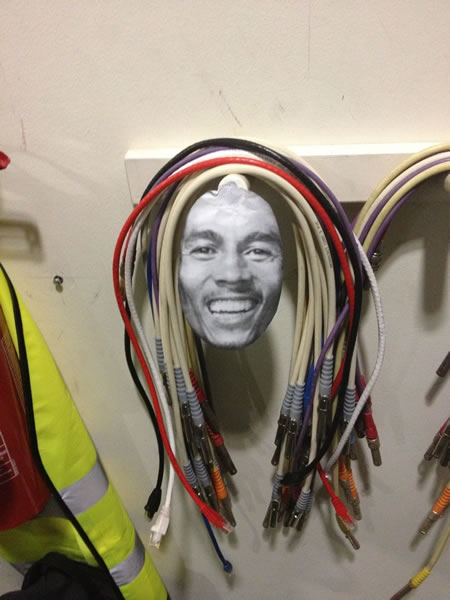
Better cable management with Bob


Seen at Boing via globalnerdy

Omnichord, Casio and Mochika into my Kaoss Pad


Hooked up my circuit bent omnichord and Casio with my Mochika and triggered samples recorded on the Kaoss Pad.

The audio is clipped, so turn down your speakers a bit. Below is a sketch of the set-up I did for the sketchbook diary I've been keeping this year. There's more of that on my other blog.